AI for Finance
Practical Applications of AI in Finance, Python and machine learning for FP&A
|
After years of working with CFOs, Fractional CFOs, Finance Directors, and Heads of FP&A through the AI Finance Accelerator and AI Finance Club, patterns emerge. Here are the ones that actually matter. I didn’t set out to train thirty thousand finance professionals. It started with a simple conviction: the tools and techniques that data scientists take for granted — machine learning, automation, AI-driven analysis — should be accessible to every finance professional on the planet, not just those lucky enough to have a data team sitting next to them. That conviction became The Financial Fox, and now working with Nicolas Boucher and building the AI Finance Club and in 2026, launched the AI Finance Accelerator. Across all of it, I’ve had the privilege of sitting in the room — virtually and physically — with CFOs at global multinationals, fractional CFOs navigating fast-growth startups, Finance Directors managing complexity with lean teams, and FP&A heads trying to do more with less, faster than ever before. What I’ve seen has reshaped how I think about AI adoption in finance. Not in the way the tech press would have you believe — not the race to deploy the shiniest new model or automate every spreadsheet overnight. Something deeper and, honestly, more human than that. Here is what I’ve learned. Every single point has been earned through watching real people succeed and fail at integrating AI into real finance work. Lesson 01: It Was Never About the Tool. It’s About the System Behind It.The most common mistake I see finance leaders make when starting their AI journey is treating it as a tool procurement problem. They ask: “Which AI should we use?” They benchmark products. They run pilots. They sit through vendor demos. And then, more often than not, they stall. This is because the real challenge was never about the tool , it was about AI literacy. The ability to understand what AI can and cannot do, to ask the right questions of it, to structure your workflows around its strengths, and to spot when it’s quietly getting things wrong. “The finance leaders winning with AI aren’t the ones using the most sophisticated tools. They’re the ones who’ve built the strongest mental models of how AI thinks — and how it fails.” Tools change quarterly. A model that’s state-of-the-art today will be a footnote in eighteen months. But the literacy you build — the understanding of prompt design, of model limitations, of how to structure a problem so that AI can genuinely help you — that compounds. It makes you better with every new tool that emerges, rather than forcing you to start from scratch each time. This is why the AI Finance Accelerator was built the way it was. Not as a product-by-product tutorial series, but as a literacy and frameworks program.
We want finance professionals to leave not knowing how to use one tool, but knowing how to evaluate, deploy, and govern any AI tool they encounter — and to build repeatable systems that their team can sustain without constant reinvention. The AI for Finance Literacy MindsetAsk yourself: if the AI tool you’re using today disappeared tomorrow, would your team’s capability disappear with it? If yes, you’ve built tool dependency — not AI literacy. AI for Finance Literacy means your team can adapt, evaluate, and rebuild using the next tool, and the one after that. Lesson 02: Data Quality Matters — But Waiting for Perfect Data Is the Biggest Mistake You Can Make.I’ve heard it hundreds of times, usually from very smart, very well-intentioned finance leaders: “We’ll start our AI program once we get our data house in order.” I understand the logic. AI is only as good as the data you feed it. Garbage in, garbage out. It’s a principle worth taking seriously. But in practice, this thinking becomes a perfect excuse for indefinite delay. The data is never fully clean. The systems are never fully integrated. The warehouse is never quite ready. Meanwhile, your competitors are learning. They’re iterating. They’re building fluency with tools that take months to genuinely master — and they’re getting those months ahead of you. Here’s what I’ve learned from watching thousands of finance professionals actually make progress: AI can help you with data quality itself. This is one of the most underestimated applications of modern AI in finance. Large language models are remarkably good at identifying inconsistencies in datasets, standardizing naming conventions, flagging anomalies, suggesting data enrichment strategies, and helping you design better data capture processes for the future. “Don’t wait until your data is clean to start using AI. Use AI to help you clean it.” The finance teams that have made the most progress in AI adoption are not the ones with the most pristine data environments. They are the ones that started moving, accepted imperfection as part of the process, and used their early AI work to simultaneously improve the very data foundations they were worried about. Start where you are. Use what you have. Let AI help you improve both as you go.
Lesson 03: Consistency Is the Only Thing That Actually Works. One-Off Learning Is Dead Money.There is an enormous market for AI conferences, one-day intensives, keynote speakers, and highlight-reel workshops. I’ve spoken at many of them. They have real value in sparking curiosity and building initial awareness. But they are not, by themselves, how transformation happens. I’ve watched organizations spend significant budgets sending their finance teams to multi-day AI summits, only to return to the office, feel briefly inspired, and then slip back into exactly the workflows they left. Three months later, when I check in, the excitement has faded and the day-to-day has reclaimed everything. The uncomfortable truth is that AI capability is a skill, and skills are built through consistent, repeated practice — not through a single immersive experience, however well-designed. Think about how you got good at financial modeling, or how your analysts became fluent in Excel. It wasn’t a seminar. It was daily repetition, making mistakes in real work, getting feedback, and gradually building pattern recognition that becomes intuition. AI literacy works the same way. What Consistency Actually Looks LikeIt doesn’t mean daily AI training sessions. It means creating regular touchpoints: weekly team check-ins on AI experiments, a shared channel for prompts and discoveries, structured monthly projects, and leadership that models continued learning rather than treating AI as “already solved.” This is precisely why the AI Finance Club was designed as an ongoing community, not a course with an end date. Because the learning doesn’t end. The tools evolve, the use cases deepen, and the only finance professionals who stay ahead are the ones who keep showing up.
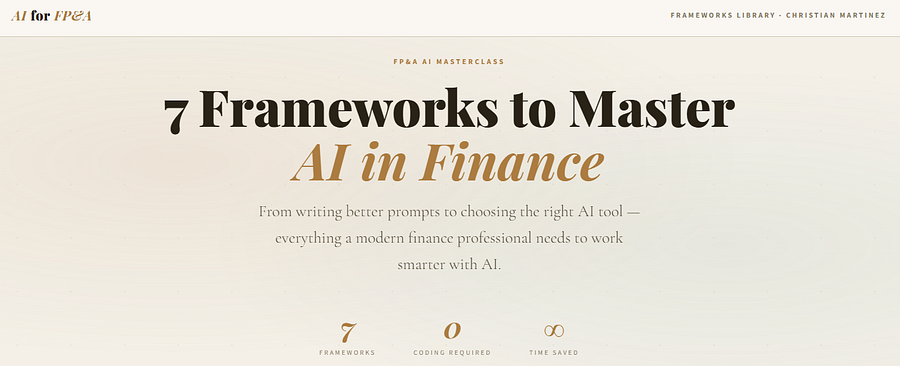
Lesson 04: Six Weeks. That’s the Window. Use It Well.After running dozens of AI for Finance learning programs and observing hundreds of individual learners, one number keeps showing up: six weeks. Six weeks of structured, consistent practice is enough time for a finance professional — regardless of their starting point — to move from curious bystander to genuinely capable practitioner. Not an AI engineer. Not a data scientist. But someone who can identify high-value use cases in their own work, design prompts that produce reliable, useful output, build simple automations, critically evaluate AI-generated financial content, and begin teaching these skills to others. Less than six weeks and most people don’t build enough neural pathways to make the learning stick. The initial enthusiasm runs out before the competence arrives. More than six weeks, and the structure tends to fade, momentum dips, and people deprioritize the learning in favor of urgent operational demands. “Six weeks is long enough to build real capability and short enough to hold attention. It’s the sweet spot between inspiration and abandonment.” If you’re designing an AI learning program for your finance team right now, build it around a six-week spine. One focused theme per week. Real projects, not hypotheticals. Weekly accountability. And a clear articulation at the start of what “capability” looks like at the end — so people know what they’re working toward and can feel the progress as they move through it. Steal our framework of the AI Finance Accelerator:
The six-week framing also makes the program organizationally legible. CFOs can approve a six-week investment more easily than an open-ended “AI transformation initiative.” It feels manageable. It creates urgency. And it produces visible results on a timeline that keeps leadership engaged. Lesson 05: The Best Learning Happens With Your Own Data and Your Own Problems.Generic AI training teaches you how to use AI on someone else’s problems. Which is interesting, occasionally inspiring, and usually forgotten within a month. The training that actually changes how you work uses your data, your reports, your variance analyses, your forecasting models, your month-end processes, your budget presentations, your specific finance team’s recurring pain points. This is the design principle at the core of everything we do in the AI Finance Accelerator. In the mastery track, participants don’t use fictional datasets. They don’t simulate finance workflows. We work with participants to identify the real, live problems they are staring at every week — and we use those as the learning substrate. This approach works for several deeply human reasons. First, the stakes are real. When you’re using AI to improve an actual forecast you’re presenting to your CFO next Tuesday, your attention is different.
The learning is sharper. Second, the results are immediately credible. When a participant shows their team what they built using their own data, the proof of concept is self-evident — there’s no translation required from artificial example to real application. Third, and most importantly: working with your own problems teaches you how to identify AI use cases — a skill that is arguably more valuable than any specific AI technique. Once you’ve solved three or four real problems using AI, you start to see them everywhere. You develop a kind of pattern recognition for where AI can add value. This is the compound interest of project-based learning. Project-Based Learning in PracticeStart with a pain point that costs your team at least 2–3 hours per week. Bring your actual data. Use AI to build a first draft solution in your first two sessions. Iterate from there. The learning that emerges from debugging a real problem is worth ten case studies about someone else’s situation.
Lesson 06: Create an AI Finance Club Inside Your Company. Learning Together Is the Only Sustainable Model.Individual AI capability is valuable. Organizational AI capability is transformational. The most powerful thing I’ve seen in organizations that have genuinely moved the needle on AI adoption is a deliberate, sustained internal community of practice — what I call “an” AI Finance Club. A group of people within the finance function who share what they’re learning, challenge each other’s assumptions, celebrate small wins, and collectively push the capability of the entire team forward. This matters because AI adoption in finance is not a one-time implementation. It is a continuous process. The tools evolve. New use cases emerge. Existing approaches need refinement. The regulatory and compliance landscape around AI-generated financial analysis is still being written. Keeping pace with all of this requires ongoing engagement — and ongoing engagement requires community. When someone figures out a prompt that dramatically improves their variance commentary workflow, that insight should spread to the entire team — not die in one person’s private ChatGPT history. When someone discovers that a particular AI output needs careful review before use in a board presentation, the whole team should benefit from that lesson. Community makes learning scale. The structural requirements for an internal AI Finance Club are minimal. You need a communication channel — a Slack group, a Teams channel, a recurring meeting slot. You need a champion: someone with enough internal credibility to model continued learning and invite others into it. And you need a culture signal from leadership that this kind of peer learning is not a distraction from “real work” but an investment in the team’s long-term effectiveness. “One person learning AI is a project. A team learning AI together is a capability. A company building that into its culture is a competitive advantage.”
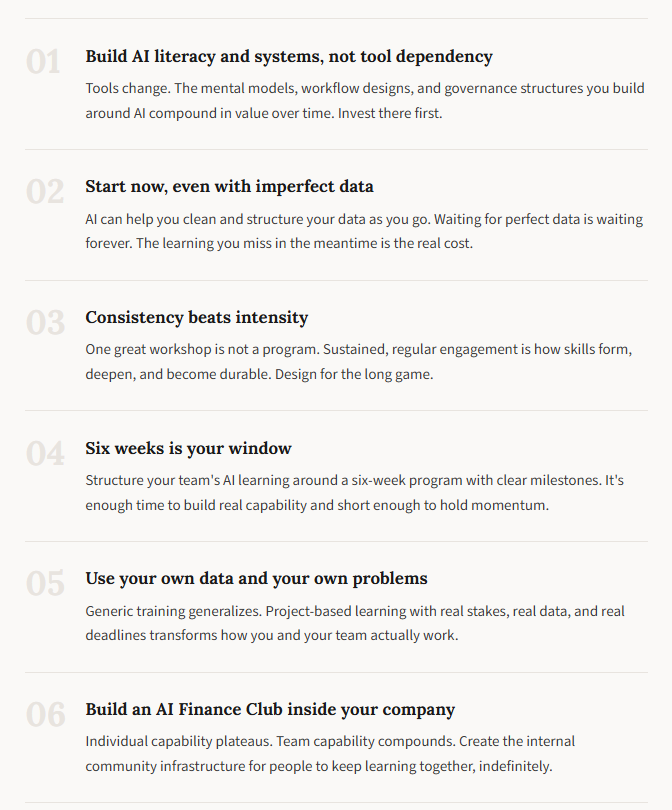
We built the external AI Finance Club for exactly this reason. Many finance leaders don’t have colleagues inside their organization to learn alongside. The club provides that community at scale: a space where CFOs, FP&A heads, finance directors, and fractional CFOs from across industries can share, challenge, and push each other forward. But the goal has always been for this external community to inspire internal ones — for the mindset to take root within companies, not just across them. The Six Lessons, In Order01 Build AI literacy and systems, not tool dependencyTools change. The mental models, workflow designs, and governance structures you build around AI compound in value over time. Invest there first. 02 Start now, even with imperfect dataAI can help you clean and structure your data as you go. Waiting for perfect data is waiting forever. The learning you miss in the meantime is the real cost. 03 Consistency beats intensityOne great workshop is not a program. Sustained, regular engagement is how skills form, deepen, and become durable. Design for the long game. 04 Six weeks is your windowStructure your team’s AI learning around a six-week program with clear milestones. It’s enough time to build real capability and short enough to hold momentum. 05 Use your own data and your own problemsGeneric training generalizes. Project-based learning with real stakes, real data, and real deadlines transforms how you and your team actually work. 06 Build an AI Finance Club inside your companyIndividual capability plateaus. Team capability compounds. Create the internal community infrastructure for people to keep learning together, indefinitely.
The finance leaders of the next decade will not simply understand balance sheets and variance analysis. They will understand how to build AI systems around them — systems that make their teams faster, more insightful, and more valuable to the organizations they serve. That future is already arriving. The question is whether you and your team are building the literacy, the habits, and the community to meet it — or waiting for the perfect moment that will never quite come. Thirty thousand finance professionals taught me this. I hope it saves you some of the time it took them — and me — to figure it out.
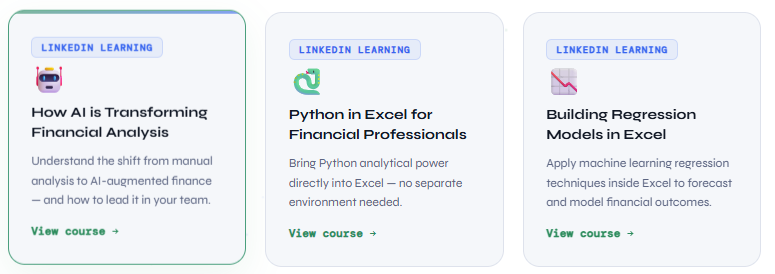
Prefer to learn AI for Finance at your own pace?If structured cohorts are not your style, these LinkedIn Learning courses let you go deep on specific skills — on your own schedule, as many times as you need. How AI is transforming financial analysis | LinkedIn Learning https://www.linkedin.com/learning/the-ai-driven-financial-analyst/how-ai-is-transforming-financial-analysis?u=0 Welcome to Python in Excel | LinkedIn Learning https://www.linkedin.com/learning/python-in-excel-for-financial-professionals/welcome-to-python-in-excel?u=0 Building regression models in Excel | LinkedIn Learning https://www.linkedin.com/learning/advanced-python-in-excel-machine-learning/building-regression-models-in-excel?resume=false&u=0
About the Author: Christian MartinezChristian Martinez is a Finance Senior Manager and AI for Finance Professor. He has trained over 20,000 CFOs, Fractional CFOs and other senior finance leaders in AI for Finance through his online courses across AI Finance Club, AI Finance Accelerator , LinkedIn Learning and YouTube. He is also the author of Smart Finance: Leveraging AI for Enhanced Financial Planning and Analysis and an international conference speaker, having presented at the World Finance Forum, World Summit AI, and the EMEA FP&A Summit. He has over 10 years of experience in FP&A, Finance Transformation, and Finance Analytics at multinational companies across The Netherlands, Australia, and Mexico. He leads a team of 40+ developers and data engineers building advanced analytics tools for finance professionals across 20+ markets worldwide. Christian holds a Master’s Degree in Finance and Data Science, Lean Six Sigma Green Belt, and Product Owner certifications.
|


AI for Finance
Practical Applications of AI in Finance, Python and machine learning for FP&A